7 Python Tricks to Flatten a List of Lists Like a Pro
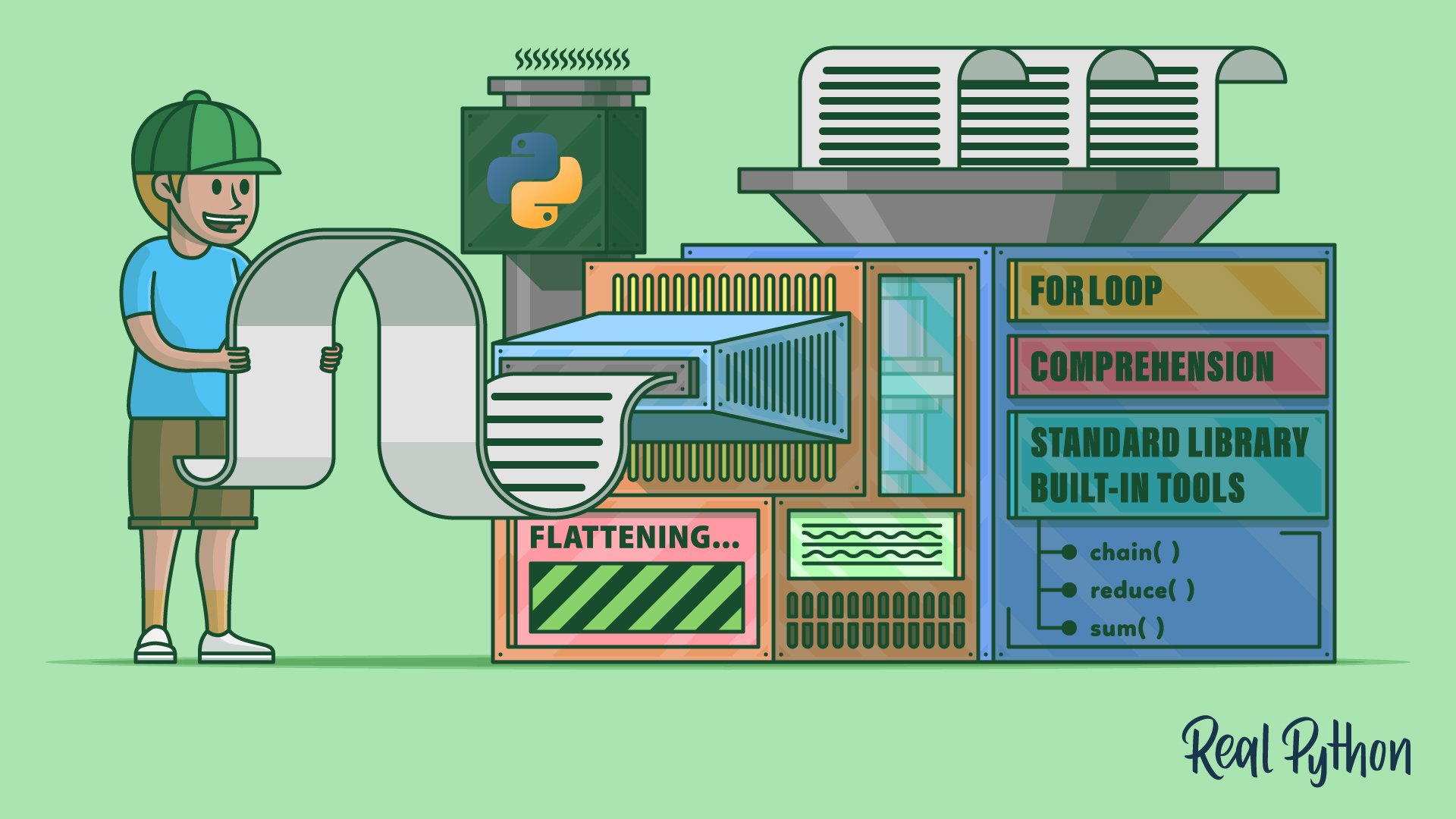
Working with multidimensional lists in Python often requires flattening them into a single, one-dimensional list. Whether you're cleaning data, preparing features for machine learning, or just simplifying nested structures, understanding how to flatten lists efficiently is a fundamental skill. This article dives into seven distinct techniques to achieve that, each with its own strengths and use cases. You'll also find internal links to skip ahead to the method that interests you most. And if you're ready to test your knowledge, don't forget the quiz at the end!
1. The Classic Nested Loop Method
This is the most straightforward approach: iterate over each sublist, then over each element inside it, and append each element to a new flat list. It's easy to read and understand, making it perfect for beginners. However, for large datasets, the explicit loops can be slower than some alternatives. Still, this method gives you full control and is a great foundation for grasping the flattening concept.
2. List Comprehension with Two for Clauses
List comprehensions offer a more Pythonic and often faster way to flatten nested lists. By placing the outer loop first and the inner loop second, you can generate a flat list in a single line: [item for sublist in nested_list for item in sublist]. This compresses the nested loop logic into an expressive construct. It's clean, readable, and performs well for shallow nesting. If you're comfortable with comprehensions, this is one of the most elegant solutions.
3. The itertools.chain() Approach
The itertools module provides a high-performance tool for flattening. Using itertools.chain.from_iterable() you can efficiently concatenate all sublists into one iterator, then convert it to a list. This method is memory-efficient and works well with large sequences because it avoids creating intermediate lists. It's a favorite among Python pros for its combination of speed and clarity. Just import itertools and call list(chain.from_iterable(nested_list)).
4. Using sum() with an Empty List Start
A clever trick uses Python's sum() function with a starting value of an empty list: sum(nested_list, []). This works because sum concatenates lists under the hood. While it's a one-liner, it's not recommended for production: it has quadratic performance due to repeated concatenation and creates many temporary lists. Use this method only for tiny lists or quick one-off scripts. It's more of a curiosity than a best practice.
5. The functools.reduce() Technique
For functional programming enthusiasts, reduce() from the functools module offers another way to flatten. By applying operator.add to combine sublists, you get a flat result: reduce(lambda a, b: a + b, nested_list). However, like sum(), this also suffers from quadratic time complexity. It's a great example of functional thinking, but for serious flattening, stick to list comprehensions or chain().
6. Flattening with numpy.flatten() / numpy.ravel()
If you're already using NumPy for numerical work, its flatten() and ravel() methods are incredibly fast. You simply convert your list of lists to a NumPy array and call one of these methods. flatten() always returns a copy, while ravel() tries to return a view for memory efficiency. This approach is ideal for large numeric datasets. But for general-purpose lists, importing NumPy just for flattening may be overkill.
7. Recursive Flattening for Arbitrary Nesting
Sometimes you encounter deeply nested lists with varying depths. Here, recursion shines. Write a function that iterates over the list, and for each element, if it's a list, recurse; otherwise, collect the element. This handles any level of nesting. You can also use a stack or queue for iterative depth-first traversal. Recursive flattening is powerful but requires caution with deep recursion (Python's recursion limit). Use it when you don't know the nesting depth in advance.
Now that you've explored these seven techniques, you're better equipped to tackle flattening tasks in your Python projects. Each method has its place: classic loops for clarity, list comprehensions for brevity, chain() for performance, and recursion for arbitrary depth. The best choice depends on your specific scenario. Ready to verify your understanding? The original quiz will challenge you to write code and answer questions on these very concepts – give it a shot!